No proof of correctness
The worker claims it ran the model you paid for. You have no way to verify it didn't return a cached, cheaper, or corrupted output.

Verifiable, private AI compute.
Powered by people, proven by hardware.
A decentralized inference network where regular people share GPU compute and earn USDC — while every answer is proven to run the right model and your prompt stays private from the worker, both by one primitive: the trusted enclave.
Centralized providers log your prompts, filter your model, and revoke access at will. The first wave of alternatives gave you ownership — but skipped the two things that actually matter.
The worker claims it ran the model you paid for. You have no way to verify it didn't return a cached, cheaper, or corrupted output.
“We don't store prompts” is not privacy. The worker still reads your prompt in plaintext — privacy by policy, not by design.
Peer Cycles closes both. Trust stops being a promise and becomes a property of the system.
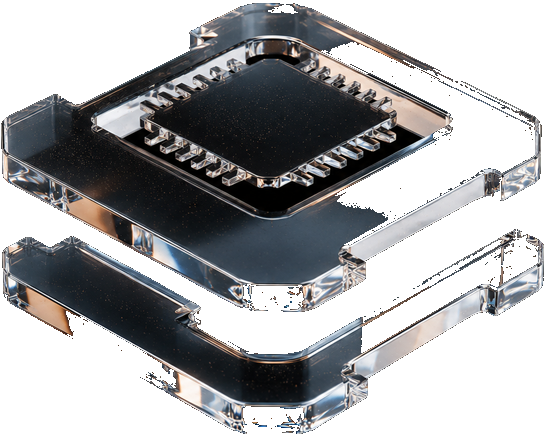
The keystone is the Trusted Execution Environment — a sealed region of a GPU or CPU that runs code no one can read or tamper with, not even the machine's owner. Peer Cycles runs on confidential GPUs (NVIDIA H100 / H200) plus CPU TEEs — Intel TDX and AMD SEV-SNP.
The enclave signs a proof of exactly which weights and which code ran. This delivers verifiability.
The worker never sees the prompt in plaintext. This delivers privacy — by construction.
Every layer builds on the trust primitive beneath it.
Any agent framework or app switches by changing one base URL. Apps and autonomous agents become customers, not just humans in a chat window. Per-request settlement runs over x402.
The orchestrator routes by reputation, measured throughput, and price — never at random. Workers that fail proofs fall down the ranking and earn less. Good actors rise.
Supply spans three worker types, each serving a different trust tier.
Fast, cheap inference in a browser tab. No privacy guarantee.
Frontier open models on real hardware.
Attested, encrypted. The premium tier.
TEE attestation. The foundation every other layer is built on.
Two production modes today — plus one research track we promise nothing about.
The worker posts a bond. Each output commits to a hash, model ID, and a fixed seed — so the run reproduces. A random subset of jobs is re-executed by independent validators.
A mismatch slashes the worker and rewards the challenger. Slashing burns supply.
The TEE signs which weights and code ran. The proof travels with the response — forgery is not possible.
Cryptographic certainty, shipped alongside every token.
A cheap zero-knowledge proof of inference. Production-grade zkML for large language models does not exist yet.
Tagged as research. We promise nothing.
The client encrypts the prompt to the enclave's attested public key.
Decryption happens only inside the TEE. The worker never sees plaintext.
The output encrypts back to the client. One mechanism covers privacy and correctness.
This isn't a recording. It streams from the live Peer Cycles node — the real orchestrator routes a job, proves it, seals a confidential prompt, catches a cheater, and settles the treasury. Every number below is computed on the spot.
Open runs entirely on your device — nothing leaves the browser. Verified routes to a real GPU worker and settles per request in USDC/SOL on Solana mainnet.
1 credit = $0.01, bought with USDC. Credits never expire and refund automatically when a job fails. You never need to hold $PEER to spend them.
Casual chat
Agents · developers
Legal · medical · proprietary
Peer Cycles speaks the OpenAI API. Point any agent framework or app at it by changing a single base URL — humans and autonomous agents alike. Per-request settlement runs over x402: no subscription, no token to hold, you pay only for what you run.
# OpenAI-compatible — switch one base URL
curl https://<your-node>/v1/chat/completions \
  -H "authorization: Bearer <account>" \
  -H "content-type: application/json" \
  -d '{
    "model": "peer-mixtral",
    "peer_tier": "verified",
    "messages": [{ "role":"user", "content":"explain attestation" }]
  }'
Tiers: open · verified · confidential. Add "stream": true for token-by-token SSE.
# 1 credit = $0.01, bought with USDC. Refunds on failure.
curl .../credits/buy -d '{ "account":"me", "usdc": 10 }'

# Out of credits? The network answers x402:
HTTP/1.1 402 Payment Required
{ "scheme": "x402", "price_credits": 15 }
No $PEER needed to spend. confidential replies ship a verifiable TEE attestation; the worker never sees your prompt.
This is the live request shape — the reference node in this repo answers it verbatim.
User sends a request through the OpenAI-compatible API or chat client.
The orchestrator reads the tier and queues the job.
It matches the job to an eligible idle worker by reputation, speed, and price.
The worker runs inference inside the enclave and streams tokens back.
On Verified, a validator may re-execute a random subset of jobs; on Confidential, attestation ships with the output.
The job completes. The worker earns USDC. A failed proof slashes the bond.
Verifiable, private AI compute. Powered by people, proven by hardware.